Item: tRecursiveRuleOtherRecursive3b
Stem:
Let a1, a2, a3,
...,
an, ... be a sequence of positive
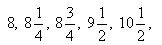
numbers. The first five terms of the sequence are given below.
 . . .
. . .
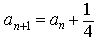
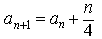
Select the correct rule for finding the (n+1)th term from the nth term.
Options:



Key:
- Observable: 4.
Score: 1;
Evidence Value: 1.
-
Student:Great work! The expression you selected is correct.
-
Teacher:The student got this item correct.
- Observable: 1.
Score: 0;
Evidence Value: 0.
-
Student:Sorry, that's not right. For an = 8, the expression you selected evaluates to: 8 + 8 = 16. But the next term in the sequence 8 1/4, not 16. So this rule does not apply to the sequence given in the question. It's a good approach to test your rule by checking it with several pairs of numbers from the sequence.
-
Teacher:The student did not get this item right.
- Observable: 2.
Score: 0;
Evidence Value: 0.
-
Student:Sorry, that's not right. Think about the following example: The first term is 8, so when n = 1, an = 8. 1 * 8 = 8. But the next term in the sequence is 8 1/4, not 8. So this rule does not apply to the sequence given in the question. It's a good approach to test your rule by checking it with several pairs of numbers from the sequence.
-
Teacher:The student did not get this item right.
- Observable: 3.
Score: 0;
Evidence Value: 0.
-
Student:Sorry, that's not right. For an = 8, the expression you selected evaluates as: 8 + 1/4 = 8 1/4. The next term is 8 1/4, so the rule works for these particular numbers. But it does not work in general. For example, when an = 8 3/4, 8 3/4 + 1/4 = 9. But the next term in the sequence is 9 1/2, not 9, so the rule fails in this case. It's a good approach to test your rule by checking it with several pairs of numbers from the sequence.
-
Teacher:The student did not get this item right.
- Observable: 5.
Score: 0;
Evidence Value: 0.
-
Student:Sorry, that's not right. For an = 9 1/2, the expression you selected evaluates as: 9 1/2 + 1 = 10 1/2. The next term is 10 1/2, so the rule works for these particular numbers. But it does not work in general. For example, when an = 8, 8 + 1 = 9. But the next term in the sequence is 8 1/4, not 9, so the rule fails in this case. It's a good approach to test your rule by checking it with several pairs of numbers from the sequence.
-
Teacher:The student did not get this item right.
Metadata:
Item Node: tRecursiveRuleOtherRecursive3b,
Difficulty: 3.
Proficiencies: RecursiveRuleOtherRecursive.